A bright new renosterveld daisy for the Overberg
A new species has just been added to the Cape Floral Kingdom, and more specifically to renosterveld. And it’s one that can only be found in the Overberg. The pretty daisy, Dimorphotheca overbergensis, was first identified as a potentially new species to science by the Overberg Renosterveld Trust team. It has now been described as a new species in the scientific journal Taxon.
According to the research paper titled Widely acclaimed but poorly named: Phylogeny and systematics of the African daisy genus Dimorphotheca, by Thaabiet Parker, Anthony Verboom, Allan Ellis, John Manning and Nicola Bergh, the taxonomy of Dimorphotheca has long been complicated. Many species look similar but are in fact genetically different, making it easy for some to go unnoticed.

Above: Morphological variation in Dimorphotheca and differences with sister genus Osteospermum: A, Elongate, closely overlapping ray floret laminae in D. pluvialis from Springbok; B, Uniformly sized, elongate, uniseriate bracts in D. montana from Seweweekspoortberg; C, Linear or linear-(ob)lanceolate, sinuate-dentate leaves in D. nudicaulis from Nieuwoudtville; D, Dissected leaves in D. pinnata from the Richtersveld; E, D. pluvialis (white) and D. sinuata (orange) co-occurring at Namaqua National Park; F, Purple-pink ray laminae in D. spectabilis from Pretoria National Gardens; G, Yellow disc floret corollas and ray laminae in D. montana from Seweweekspoortberg in the Western Cape; H, Azure-blue disc floret corollas and white ray laminae in D. ecklonis cultivated at Steenbras Dam; I, The horticultural “spider” form; J, The classic yellow ray laminae of Osteospermum with short involucral bracts in O. scabrum from Nature’s Valley in the Eastern Cape; K, Overlapping and wooly bracts in O. junceum from Houw Hoek; L, Corymbose, branching inflorescences in O. microcarpum from Kamieskroon surrounds. — Photos: A & H, T. Parker; B & G, G.A. Verboom; C, J & L, Robert Sadler; D, Nick Helme on iNaturalist; E & K, A.G. Ellis; F, Marinda Koekemoer; I, www.ballstraathof.co.za (used with permission).
A case of mistaken identity
That’s exactly what happened with D. overbergensis: as it was mistaken for other species like D. cuneata and D. tragus.
What sets D. overbergensis apart is its bright yellow flowers, which stand out from the white or orange blooms of its closest relatives. The plant is a small, woody shrub that grows only in the Overberg’s lowland renosterveld – one of the most threatened ecosystems in South Africa. Unlike similar species, its leaves are narrow and lance-shaped, and it rarely produces seeds from its outer (ray) flowers.
According to ORT CEO Odette Curtis-Scott, “Finding a new species in this region shows just how special renosterveld is and how much exploring we still have to do. There are still many plants out there waiting to be identified as species that are new to science.”

Thriving in protected habitats
Dimorphotheca overbergensis has not been listed on the South African National Biodiversity Institute (SANBI) Red List yet. It occurs in Critically Endangered Western and Central Rûens Shale Renosterveld and was originally found on one of the ORT’s conservation easements, Kleindam.
Odette says, “The publication of Dimorphotheca overbergensis also highlights the value of local conservation work and knowledge. It was through on-the-ground surveys that this plant was spotted. Our ongoing work with private landowners holds the key to the future of these unique, irreplaceable and biodiversity-rich habitats.”

Above: Morphology of Dimorphotheca overbergensis: A, Top-view of inflorescence; B, Bracts and underside of rays; C, Immature disc cypselae; D, Growth form. Growth form picture showing species growing from within a plant of another genus. — Photos: N.G. Bergh.

Above: Map showing known distribution of Dimorphotheca overbergensis and D. reticulata in the Western Cape of South Africa. Dimorphotheca dregei localities also depicted to show geographic separation from D. reticulata, which was formerly the variety D. dregei var. reticulata. Important towns near to species localities also depicted.

Black Harrier research: More satellite tags urgently needed
Please consider donating to the Black Harrier Project, either directly via our online donation platforms, or by contacting the ORT directly.

Latest Renosterveld News
Renosterveld doesn’t follow a calendar. This year our renosterveld landscapes in the Overberg seemed convinced that spring had already arrived early in August.
Supporting landowners for a better farm: What we do
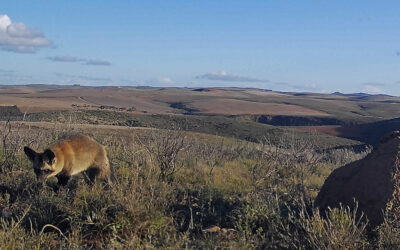
When the Overberg Renosterveld Conservation Trust signs an easement with landowners in the Overberg, it’s only the start of the journey – and the work.

Restoring renosterveld: Sausages and seeds to the rescue
In our Overberg renosterveld landscapes, the ORCT has adopted a number of restoration activities, funded primarily by WWF South Africa.
A busy year for the Veld School: Experiencing nature on our doorstep
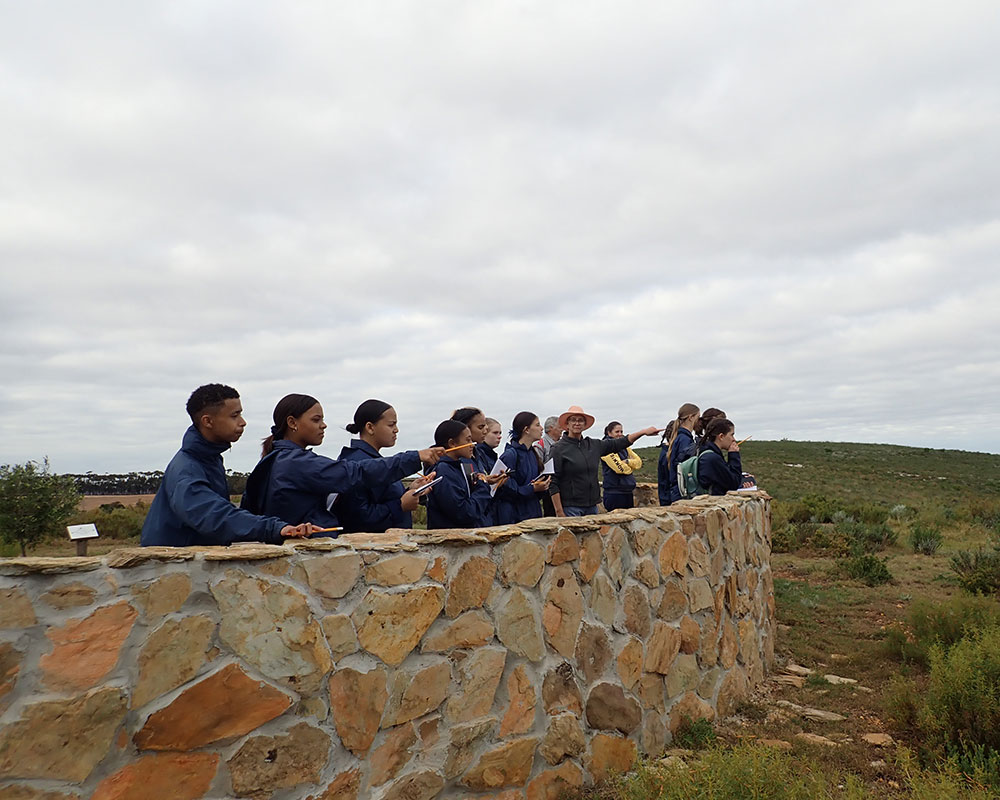
One year after the launch of the Veld School, and the Overberg Renosterveld Conservation Trust (ORCT) has touched the lives of 370 learners in the Overberg, showing them the importance of protecting our precious renosterveld.
Getting intimate with an Overberg endemic: Agulhas Long-Billed Lark
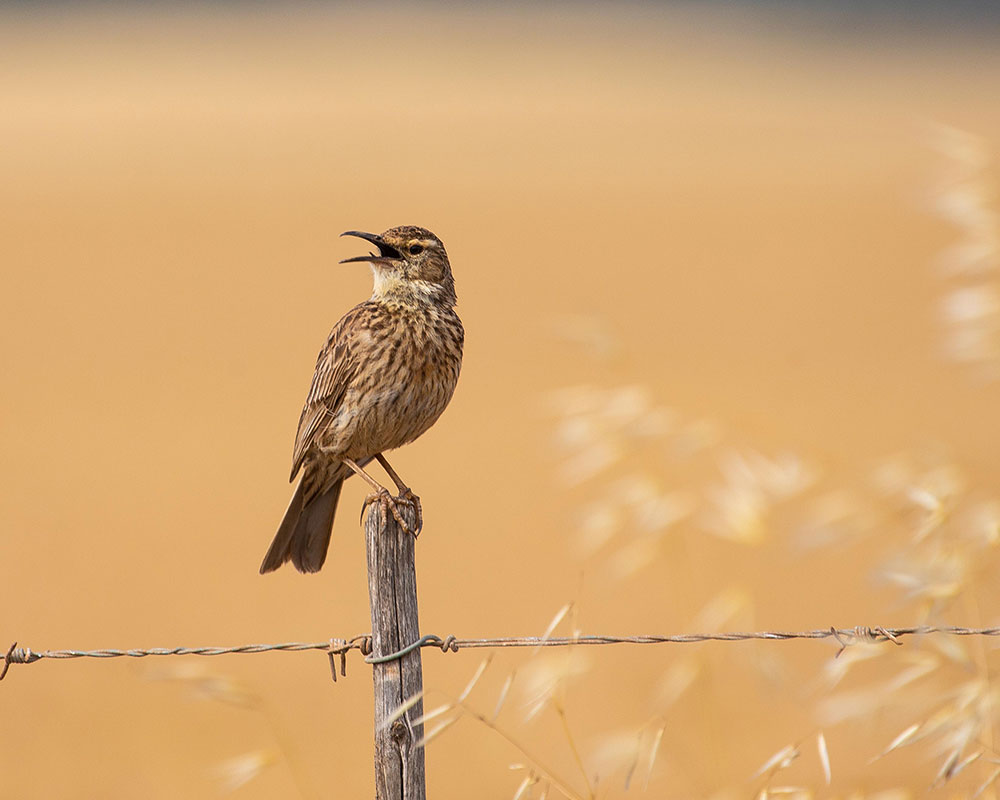
The Agulhas Long-billed Lark’s distinctive repertoire of vocalisations makes it easy to detect in the field despite its fairly nondescript plumage. When nesting, it is alert, shy and secretive, but patience and determination brought exciting new data from 29 nests.

Exploring, through the lens, intricate and miniature life forms
As the proponents of an easily overlooked shrubland, still underrated by landowners and ecologists alike, we rely heavily on taking striking images from within renosterveld to ‘sell’ our story.
Islands and Harriers: the fight for survival
This year, I was honoured to be offered a once-in-a-lifetime trip to Réunion Island, through a university exchange programme between the University of Cape Town