A test for new tech: SA’s largest wind farm comes to the Overberg
A new wind farm approved near Swellendam is set to be the biggest in South Africa. But in the heart of the Overberg, this also means an added layer of risk for our indigenous species.
For the Overberg Renosterveld Trust (ORT), the big question is: How will this new development affect the surrounding ecosystem, in particular our threatened birds?
The project will also test the efficacy of various methods aimed at mitigating wind farms’ impacts on birdlife – a handful of which are new to South Africa, or entirely new technology.
Construction of the Overberg Wind Energy Farm (WEF), developed by Red Rocket Energy, started in March 2025. When completed, it will be the largest wind farm in the country with 63 turbines and a total installed capacity of 400MW.
The site is located 12km west of Swellendam, south of the N2. Plans show the turbines surrounding an island of ecotonal renosterveld and lowland fynbos.


Above: Black Harriers (Circus maurus) – (c) Odette Curtis-Scott
This area is used regularly by Black Harriers, southern Africa’s rarest endemic raptor.
“Our data show 11 of our tagged birds passing through the site where the wind farm will be,” says Dr Odette Curtis-Scott, CEO and founder of the ORT.
There are currently fewer than 1,300 of these Endangered birds left in the wild, making them rarer than rhinos. Other species that could be adversely affected are the Denham’s Bustard, Blue Crane, White Stork and Verreaux’s Eagle – with known nest sites of the latter located close to the wind farm site.


Top right: White Stork (Ciconia ciconia). Top left: Denham’s Bustard (Neotis denhami). Bottom: Verreaux’s eagle (Aquila verreauxii)
Trusting the science
More wind farms mean a greater shift towards renewable energy and less reliance on fossil fuels, which sounds like a step in the right direction.
But a wind farm is still a major industrial project that disrupts the surrounding environment. Like any human development, it will inevitably leave its footprint on the ecosystem.
The challenge has been finding ways to minimise this footprint as much as possible, says Curtis-Scott. This is only possible if developers and conservationists work together and consult accurate and up-to-date data.
“When the initial studies for the wind farm were done, we didn’t know what we know now,” says Curtis-Scott.
Together with HawkWatch International and BirdLife South Africa, the ORT worked with the developers to make sure the latest research is taken into account. After much negotiation, the developers agreed to implement additional mitigation measures, including:
● Patterned blades: All turbines will feature one patterned blade to increase visibility to the birds. This method has proven effective in other countries and some recent studies in South Africa. The developers will consult with the ORT and other specialists to choose the specifications for the patterning, based on the latest scientific findings.
● Shutdown-on-demand (SDOD): This method is fairly successful when used in combination with other measures. When a Species of Conservation Concern (i.e. a species that is listed as threatened on the Red Data List) approaches a turbine, the spinning blades will be shut down (or drastically slowed down) to allow safe passage. The developers have committed to two kinds of SDOD:
● A new automated SDOD, which uses AI to “recognise” species and trigger mitigation measures automatically. This technology is still young and has varying success in identifying smaller raptors like harriers and kestrels.
● There will also be observer-led SDOD, in which on-site human observers keep watch and trigger the system if needed. This will be instrumental for effective SDOD while the AI is still “learning”. Observers will be used for the first 12 months at least and thereafter during peak Harrier activity periods. They will be stationed at turbines whenever the blades are turning – during daylight hours, seven days a week, including public holidays.
● Consulting experts: To handle matters related to the safety and wellbeing of birds, the wind farm will appoint an independent avifaunal specialist. This appointment will be done with inputs from the ORT and other conservation groups.
● Scrapping a turbine: The developers agreed not to construct one turbine that was initially planned in an area frequented by one of the ORT’s tagged Black Harriers.
● Safer infrastructure: All new infrastructure – like roads and power lines – must be as minimal and non-intrusive as possible. Bird flight averters will also be attached to all new overhead power lines.
● Reporting & research: A carcass search programme will be developed and enforced for the lifespan of the wind farm to scout for any possible collision victims. Any fatalities of Species of Conservation Concern – including Black Harriers – will be reported to the ORT and BirdLife SA within 24 hours. Fatalities of other avifaunal Species of Conservation Concern will also be recorded and reported to the appointed specialist. Activity monitoring reports for Black Harriers and Verreaux’s Eagles will also be compiled.
The results of these mitigation measures will be assessed and adjusted annually, according to the appointed specialist’s recommendations. There are also additional measures in place, should a new breeding site for a Species of Conservation Concern be discovered on the site.

Above: Blue Cranes – (c) LoveGreen
A learning curve ahead
The new development will be a crucial test of the efficacy of these mitigation methods, and the operational data could be key in improving them further.
“Only time will tell whether these new measures are effective enough,” says Curtis-Scott. “We will all learn from this together, find what works best and see where there are still gaps.”
Red Rocket has also committed to implementing various ‘restoration’ activities on the site, but this could prove to be a double-edged sword: improving habitats will make the area more attractive for species like the Black Harrier to breed – but this will all happen in the middle of a wind farm.
“We want to see the natural habitats in the Overberg’s wheatbelt improved and cared for, but if they attract birds that previously did not use the site and place them at higher risk of turbine collision, then we will have another problem. We sincerely hope that the various tiers of mitigation will keep the birds safe.”
The adopted mitigation measures almost exclusively target the potential negative impacts on birds, while there are also some measures in place to prevent bat collisions, which is another major concern. But these are not the only animals at risk.

Left to right: Genus Enicospilus, Jewel Beetle (Acmaeodera decemguttata), Digger Bee (Amegilla sp.) – (c) Odette Curtis-Scott
Understanding the impact on ecosystems
“These measures do not – and cannot – account for other more subtle impacts, such as the displacement of animals from the localised environment or the killing of insects which are critical parts of the already broken lowland ecosystems of the Overberg,” says Curtis-Scott.
“Studies in other parts of the world show that a single turbine can kill as many as 40 million insects a year. This kind of impact needs a lot more research. We don’t yet fully understand the impact that turbines have on ecosystems.”
Thus far, the norm has been placing these turbines on the edges of indigenous veld patches, which are already under enormous ecological pressure.
“There is no doubt that this wind farm will be impacting ecological processes,” says Curtis-Scott. “We hope that, in future, the relevant authorities will be less inclined to approve proposed developments this close to threatened habitats. But right now, we just want everything to remain transparent. We hope the developers stay true to their commitments, and that zero harriers get killed – because we can’t afford to lose any more.”

Why the ORT is part of the Overberg Conservation Alliance
That’s why we’re proud to be a founding member of the Overberg Conservation Alliance (OCA), a collaboration between four conservation organisations working across the Overberg.
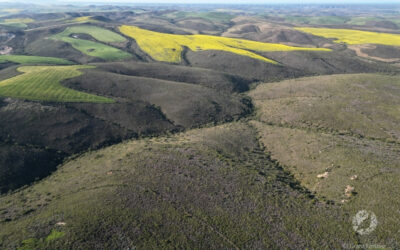
Regenerative farming: Do you really know your farm?
Speaking at a Regenerative Agriculture Landowner’s Day organised by the Overberg Renosterveld Trust in partnership with WWF South Africa in June
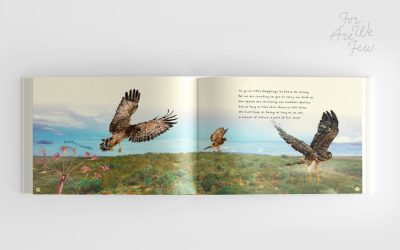
A book for all ages, to bring out the child in you
A new, richly illustrated children’s book is hoping to inspire a lifelong love of nature by telling the story of one of South Africa’s most threatened birds – the Black Harrier, BirdLife South Africa’s Bird of the Year for 2026.