
The discovery of a secretive Oxalis creates a botanical stir
By Grant Forbes, Conservation Manager: ORCT
An ecological burn on a farm near Napier has led to the appearance of a most unusual Oxalis species. It’s a find that has created a stir of excitement amongst the experts. So much so that a group of botanists from the Stellenbosch University and the Botanical Society of South Africa headed out to visit the site, in order to collect genetic material for safekeeping.
The excitement started after an ecological burn late in summer, supported by the Overberg Renosterveld Conservation Trust. After noticing the pretty Oxalis growing in the post-burn veld, I uploaded a picture of it to iNaturalist. It was Dr Kenneth Oberlander whose identification of the specimen caused a real stir. He identified it as Oxalis duriusula – a species known from fewer than 15 localities, mostly from the western Overberg and seemingly limited to clay soils.
Oxalis duriuscula was named by Friedrich Richard Rudolf Schlechter in 1897, duriuscula meaning somewhat hard, rough or harsh, possibly referring to its rough feel of the plant or the environment it grows in.


Top: Oxalis truncatula. Bottom: Oxalis duriuscula. Photos by Grant Forbes

Finding renosterveld treasures in unexpected places
Unlike many of the flashier vegetation types (like forests or fynbos), renosterveld shrublands tend to look extremely drab and lifeless during the peak summer season. This is because the peak flowering season happens over spring and because summer in the Western Cape tends to be dry, hot and windy.
Black Harrier collisions with wind turbines
A third Black Harrier has been killed by the blades of wind turbines, on a wind farm situated between Bredasdorp and Swellendam. The Overberg Renosterveld Conservation Trust (ORCT) is now calling for …
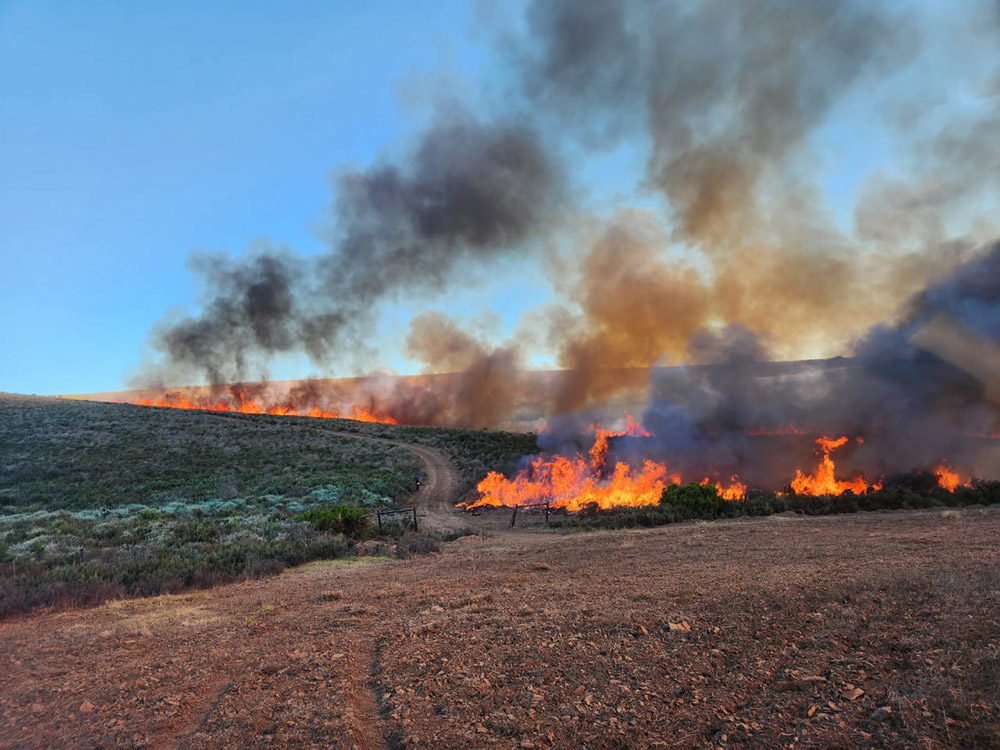
Fiery restoration action across farm boundaries
The ORCT and the landowners successfully implemented these controlled burns in mid-March with the support of the Ecosystem Services Team of the Nuwejaars Wetlands Special Management Area (NWSMA). Thanks to the Greater Overberg Fire Protection Association (goFPA).
A spectacular find of an evasive species
These ‘surings’ or wood sorrels, as they are also known, have been evading us and many other botanists. It is quite a find when you do finally see them. Fire is not a driver necessarily for Oxalis, but the fire seems to have opened the vegetation up for them to flourish. Late April we found spots of these bulbous dicots flowering somewhat prolifically, with Oxalis truncatula and O. stellata.
Oxalis is a global genus with about 230 species recorded in South Africa, and the seventh largest genus in the Cape Floristic Region. Although the centre of diversity is found in the winter-rainfall region, representatives are also found in other vegetation types in South Africa and Namibia. About 44 of these are listed as threatened, of which two – including Oxalis duriuscula – are found in the Overberg.
The Oxalis experts visit the ORCT
This exciting discovery then led to a very special visit: Prof Leanne Dreyer (Stellenbosch University), Annerie Senekal (Stellenbosch University Botanical Garden, or SUBG), Danielle Izaaks (Stellenbosch University) and Kayleigh Murray (Botanical Society of South Africa) visited us to verify and collect genetic material for safekeeping of the species. The Oxalis research collection at SUBG has been built up by Prof Dreyer for over 20 years and now holds nearly 200 Oxalis species. The collection is used to support research on the genus and to conserve threatened species.

Above: Oxalis duriuscula. Photos by Grant Forbes
In fact, the field trip made us aware of just how prolific the species is at this location: it took some time for one of the researchers to find a specimen. But soon you heard ‘found another here’ repeatedly, even though we had missed the peak of the flowering. Some fruit and the last remaining flowers were recorded as these Endangered and range-restricted plants replenish their bulbs, before disappearing once more, hopefully to be seen again next year.

Left and right: Oxalis duriuscula. Photos by Annerie Senekal (left) and Kayleigh Murray (right)
