A bright new renosterveld daisy for the Overberg
A new species has just been added to the Cape Floral Kingdom, and more specifically to renosterveld. And it’s one that can only be found in the Overberg. The pretty daisy, Dimorphotheca overbergensis, was first identified as a potentially new species to science by the Overberg Renosterveld Trust team. It has now been described as a new species in the scientific journal Taxon.
According to the research paper titled Widely acclaimed but poorly named: Phylogeny and systematics of the African daisy genus Dimorphotheca, by Thaabiet Parker, Anthony Verboom, Allan Ellis, John Manning and Nicola Bergh, the taxonomy of Dimorphotheca has long been complicated. Many species look similar but are in fact genetically different, making it easy for some to go unnoticed.

Above: Morphological variation in Dimorphotheca and differences with sister genus Osteospermum: A, Elongate, closely overlapping ray floret laminae in D. pluvialis from Springbok; B, Uniformly sized, elongate, uniseriate bracts in D. montana from Seweweekspoortberg; C, Linear or linear-(ob)lanceolate, sinuate-dentate leaves in D. nudicaulis from Nieuwoudtville; D, Dissected leaves in D. pinnata from the Richtersveld; E, D. pluvialis (white) and D. sinuata (orange) co-occurring at Namaqua National Park; F, Purple-pink ray laminae in D. spectabilis from Pretoria National Gardens; G, Yellow disc floret corollas and ray laminae in D. montana from Seweweekspoortberg in the Western Cape; H, Azure-blue disc floret corollas and white ray laminae in D. ecklonis cultivated at Steenbras Dam; I, The horticultural “spider” form; J, The classic yellow ray laminae of Osteospermum with short involucral bracts in O. scabrum from Nature’s Valley in the Eastern Cape; K, Overlapping and wooly bracts in O. junceum from Houw Hoek; L, Corymbose, branching inflorescences in O. microcarpum from Kamieskroon surrounds. — Photos: A & H, T. Parker; B & G, G.A. Verboom; C, J & L, Robert Sadler; D, Nick Helme on iNaturalist; E & K, A.G. Ellis; F, Marinda Koekemoer; I, www.ballstraathof.co.za (used with permission).
A case of mistaken identity
That’s exactly what happened with D. overbergensis: as it was mistaken for other species like D. cuneata and D. tragus.
What sets D. overbergensis apart is its bright yellow flowers, which stand out from the white or orange blooms of its closest relatives. The plant is a small, woody shrub that grows only in the Overberg’s lowland renosterveld – one of the most threatened ecosystems in South Africa. Unlike similar species, its leaves are narrow and lance-shaped, and it rarely produces seeds from its outer (ray) flowers.
According to ORT CEO Odette Curtis-Scott, “Finding a new species in this region shows just how special renosterveld is and how much exploring we still have to do. There are still many plants out there waiting to be identified as species that are new to science.”

Thriving in protected habitats
Dimorphotheca overbergensis has not been listed on the South African National Biodiversity Institute (SANBI) Red List yet. It occurs in Critically Endangered Western and Central Rûens Shale Renosterveld and was originally found on one of the ORT’s conservation easements, Kleindam.
Odette says, “The publication of Dimorphotheca overbergensis also highlights the value of local conservation work and knowledge. It was through on-the-ground surveys that this plant was spotted. Our ongoing work with private landowners holds the key to the future of these unique, irreplaceable and biodiversity-rich habitats.”

Above: Morphology of Dimorphotheca overbergensis: A, Top-view of inflorescence; B, Bracts and underside of rays; C, Immature disc cypselae; D, Growth form. Growth form picture showing species growing from within a plant of another genus. — Photos: N.G. Bergh.

Above: Map showing known distribution of Dimorphotheca overbergensis and D. reticulata in the Western Cape of South Africa. Dimorphotheca dregei localities also depicted to show geographic separation from D. reticulata, which was formerly the variety D. dregei var. reticulata. Important towns near to species localities also depicted.

Over 1,000 specimens strong: Growing our renosterveld herbarium
Herbarium specimens are only as good as their collection, pressing and curation; and these have been of the highest quality.

A test for new tech: SA’s largest wind farm comes to the Overberg
A new wind farm approved near Swellendam is set to be the biggest in South Africa. But in the heart of the Overberg, this also means an added layer of risk for our indigenous species.
Pedals, plants & peace: A renosterveld stop on the Overberg Meander
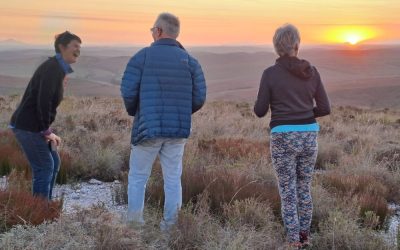
How does a week of gravel cycling through the Overberg’s rolling hills and secret valleys sound? If you’re drawn to quiet back roads, big skies, and even bigger adventures, cyclist Brenda Silberbauer and her crew have a tip for you: make sure the Haarwegskloof Renosterveld Reserve is on your route.
World’s first renosterveld app launched – your ideal outdoor partner
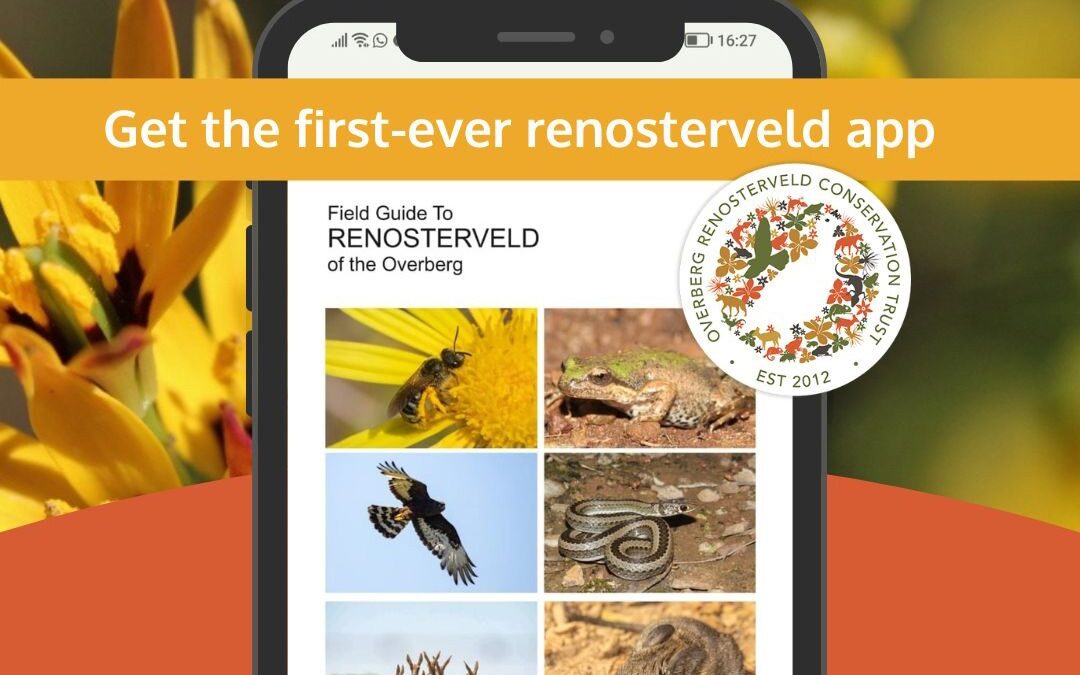
The Overberg Renosterveld Conservation Trust (ORCT) has launched the world’s first renosterveld mobile phone app, called Field Guide to Renosterveld. This allows you to identify 1 600 plant and animal species during your renosterveld adventures, all in the palm of your hand.
Veld School: “Breathing in nature, to live it”
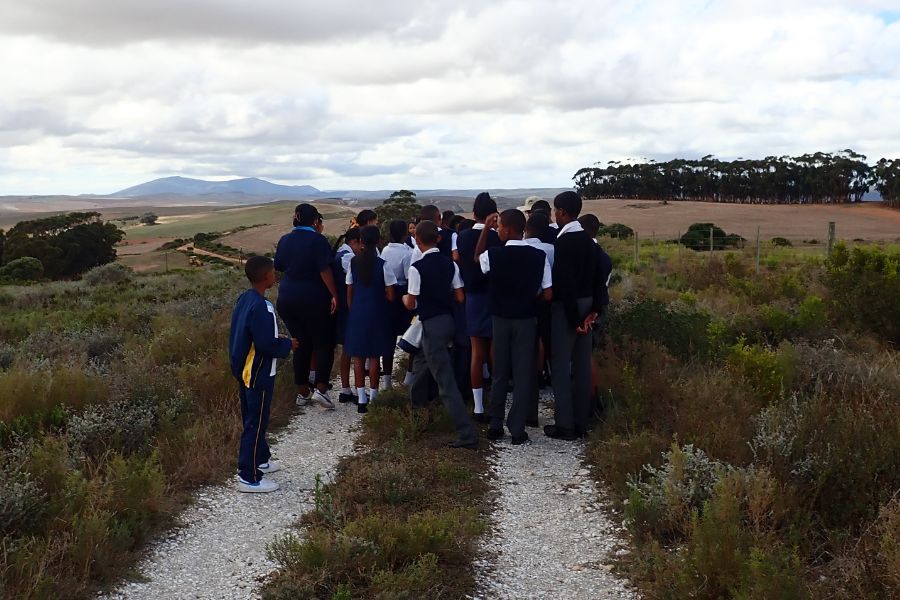
Our Veld School is a project close to our hearts. Launched back in 2022 with support from the National Lotteries Commission and ENGIE (formerly known as BTE Renewables), the programme invites tomorrow’s botanists, scientists and conservationists into the field to teach them about our natural environment.

The discovery of a secretive Oxalis creates a botanical stir
An ecological burn on a farm near Napier has led to the appearance of a most unusual Oxalis species. It’s a find that has created a stir of excitement amongst the experts.

Crassula | Providing an unlikely meal for hungry pollinators
The Crassula genus – a prominent member of the Crassulaceae family – is especially important to hungry pollinators come winter.

Reversing biodiversity loss through restoration
While big goals are set on international platforms to prevent further loss of biodiversity, organisations like the ORCT are working tirelessly to halt and reverse the loss of biodiversity at ground level with landowners and stakeholders.